


Jute twine has become one of the most in-demand natural packaging materials in global markets. Importers, retailers, and large distributors are actively shifting toward it because it is cost-effective, biodegradable, and versatile enough for industrial, agricultural, and commercial use. This article explains where to buy jute twine in bulk, what to check before selecting a supplier, and why Bangladesh remains the most reliable sourcing hub. You will also find comparisons of top manufacturers, pricing insights, certifications, and buying tips based on real industry data.
What Is Jute Twine and Why Do Importers Prefer It?
Jute twine is a natural fiber twine made from processed jute plants, designed for packaging, agriculture, crafts, and retail use. It is strong, biodegradable, and affordable, which makes it one of the most widely traded natural packaging materials worldwide.
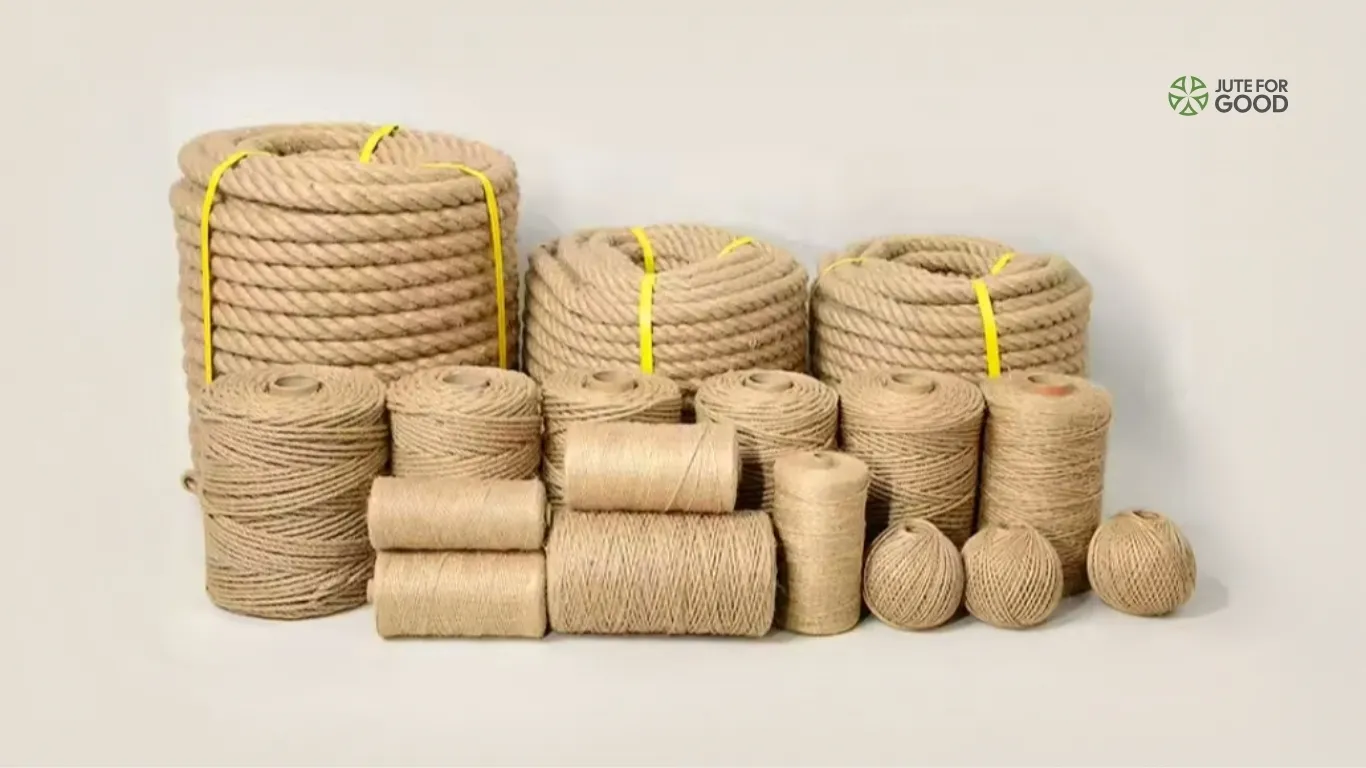
Many global importers prefer jute twine because demand for eco-friendly packaging is rising. Studies show that over 60 percent of consumers now choose biodegradable options, pushing brands to replace synthetic twine with natural materials. Jute is renewable, widely available, and requires minimal processing, making it a practical alternative.
Demand stays consistent because multiple industries rely on it. Agriculture uses it for crop tying, nurseries for plant support, shipping companies for packaging, and craft businesses for decorative work. These diverse applications create steady repeat orders, stable margins, and a reliable supply chain supported by strong production in Bangladesh and India.
What Should Buyers Look for When Purchasing Jute Twine in Bulk?
Importers often compare fiber quality, ply strength, packaging type, and certifications before confirming a commercial order. Understanding these factors helps avoid weak tensile strength, blended fibers, weight shortages, and other common issues faced by new buyers.

1. Fiber Quality and Grade
Fiber quality refers to the purity, color uniformity, and strength of the jute used to produce twine. Higher-grade jute has a golden-brown color, a smoother feel, and greater tensile strength. Lower-grade fiber often includes blends or short fibers that reduce durability. Most manufacturers classify twine based on industrial, agricultural, or retail-grade needs. Importers looking for long-term supply usually demand hydrocarbon-free jute because it meets global food-contact and packaging standards. Based on industry data, hydrocarbon-free fiber contains less than one milligram of petroleum residue per kilogram, making it suitable for sensitive applications.
2. Twine Thickness and Ply Options
Jute twine is available from 1 ply to 6 ply, and sometimes even higher depending on industrial requirements. Ply determines how many strands are twisted together, which impacts tensile strength and load-bearing capacity. A 2 ply twine may be used for basic packaging, while 4 ply or 6 ply is common in agriculture and heavy-duty bundling. Many importers specify ply strength in kilograms during sampling to avoid inconsistent production. Commercial buyers also check twist quality, as uneven twisting leads to breakage under pressure.
3. Packaging Options Including Ball, Spool, and Cone
Packaging styles vary based on use. Ball packaging is popular with craft stores and retailers because it displays well. Spools are common in agriculture and manufacturing since they allow continuous use. Cones work best for industrial machines that need smooth unwinding. Buyers often choose custom weights like 100 grams, 250 grams, 500 grams, or large industrial cones over one kilogram. Selecting the right packaging helps reduce waste and improves efficiency.
4. MOQ, Lead Time, and Customization
Minimum order quantity varies by supplier. Large mills may require five tons or more, while medium manufacturers often accept smaller trial orders. Lead times usually range from fifteen to thirty days, depending on customization. Requests for dyed, polished, or private-label packaging can extend production. Most buyers approve samples first to confirm color, ply, twist, and fiber grade before bulk manufacturing.
5. Certifications to Ensure Quality
Certifications are important because they confirm that the jute twine meets international quality and safety standards. Importers rely on them to ensure consistency, avoid compliance issues, and streamline customs clearance in regulated markets.
- ISO certification for quality management
- OEKO-TEX certification for material safety
- SGS testing reports for fiber strength and composition
- Hydrocarbon-free certification for food-contact and export requirements
Export-oriented mills in Bangladesh usually provide these documents as part of their standard QC and export process.
Best Places to Buy Jute Twine in Bulk Worldwide
Bulk buyers can purchase jute twine directly from manufacturers, through regional distributors, or from online B2B marketplaces. Each sourcing method has its own benefits depending on budget, volume, and expected delivery speed. The next sections explain each option in detail to help importers choose the most suitable path.
Direct From Manufacturers in Bangladesh
Bangladesh is the largest jute-producing country and supplies more than 90 percent of the world’s high-grade jute twine. Buying directly from Bangladeshi mills gives importers access to factory pricing and consistent fiber quality, especially for large-volume orders. Production capacity is also significantly higher in Bangladesh because of hundreds of integrated jute mills that process raw fiber to finished twine under one supply chain. Importers working with long-term contracts often get custom specifications such as packaging weight, ply variation, branding, and dyeing options at competitive rates.
Importers and Distributors in the USA, UK, and EU
Buyers requiring lower quantities or urgent delivery often purchase from local distributors in major markets such as the USA, UK, Germany, and France. These resellers maintain inventory, which means no waiting time for production or international shipping. Prices are higher than factory sourcing, but domestic delivery is faster and suitable for retailers who restock frequently. Many distributors also repack twine in custom labels for craft stores and online retail platforms, which makes them ideal for small to medium businesses.
Online B2B Marketplaces
Platforms like Alibaba, IndiaMART, and Amazon Business connect international buyers with jute suppliers from multiple regions. These marketplaces allow buyers to compare prices, check reviews, and verify supplier performance. However, many listings include traders rather than manufacturers, which increases cost and reduces transparency. Importers using marketplaces must carefully check sample quality and inspect documentation to avoid blended fiber or inconsistent ply strength. Despite these risks, marketplaces remain popular for trial orders.
Eco-friendly Packaging Suppliers
The demand for biodegradable packaging has created a new category of eco-focused suppliers. These companies offer small MOQs, color-dyed twine, and retail-ready packaging tailored for gift shops, craft stores, and eco brands. Although their per-unit price is higher, they offer a wider variety of designs and quick turnaround times. Many also ship directly to Amazon FBA warehouses for retail sellers.
Why Is Bangladesh Considered the Best Source for Bulk Jute Twine?
Bangladesh is the world’s leading producer of high-quality jute fiber and the largest exporter of jute twine. Importers choose Bangladesh because it combines raw material availability, large-scale production, and government-backed quality control. This creates a stable sourcing environment with consistent output for global buyers. The country supplies jute twine to more than 120 nations every year, which shows how reliable the supply chain is.
Most Competitive Pricing in the Global Market
Bangladesh offers the most affordable jute twine rates because raw jute is grown widely across the country. Farmers produce millions of tons of fiber every year, and mills process it locally without importing materials. This short supply chain lowers production cost by nearly 25 percent compared to regions that import jute fiber. Exporters also benefit from lower labor costs and favorable government policies, which help maintain competitive wholesale pricing. This is one of the main reasons international buyers choose Bangladesh for bulk orders.
Access to Raw Jute Mills and Large Production Capacity
Bangladesh has hundreds of jute mills producing thousands of tons of twine each month. Many operate fully integrated facilities where fiber processing, spinning, twisting, dyeing, and packaging happen in one place, ensuring faster lead times and consistent quality. Studies show that Bangladesh supplies nearly 80 percent of the world’s export-grade jute twine, giving importers a stable, long-term sourcing base without supply risks.
Custom Sizes, Ply Options, Packaging, and Branding
Global buyers often need specific ply strengths, custom twists, colors, or private-label packaging. Bangladeshi manufacturers handle these customizations directly at the factory. Twine is available in ball, spool, or cone formats in various weights. This flexibility helps importers serve different markets, from agriculture to retail, while supporting branded or private-label products.
Fast Shipping to USA, EU, Middle East, and Asia
Bangladesh ships jute twine efficiently through Chattogram and Mongla ports, offering predictable transit times of 18 to 30 days for the USA and EU, and under 15 days for the Middle East and Asia. Exporters also provide tracking, fumigation certificates, and complete documentation, helping buyers clear customs smoothly and making Bangladesh a reliable sourcing destination.
Stable Quality Due to Government Monitoring and Standards
Bangladesh maintains stable jute twine quality through government-regulated standards for fiber grade, moisture level, and packaging weight. Mills must follow strict guidelines, ensuring consistency even in large-volume orders. Many exporters also use third-party testing agencies like SGS and OEKO-TEX to provide additional quality assurance.
Top Jute Twine Manufacturers and Wholesale Suppliers in Bangladesh
Bangladesh hosts several globally recognized jute twine exporters. The following list includes the top five industry-respected suppliers based on quality, reliability, export performance, and buyer satisfaction.
1. Jute For Good – Premium Eco-Friendly Jute Twine Manufacturer
Website: https://www.juteforgood.com
Jute For Good is one of the most trusted jute manufacturers in Bangladesh, supplying premium-grade jute twine to global markets including the USA, Europe, Middle East, Africa, and Asia. The company focuses on sustainability and produces polished, natural, and dyed jute twine with strict quality control. Many importers prefer them because they provide certifications, fast production timelines, and customized packaging.
Products Offered:
- Natural, polished, and dyed twine
- One to six ply industrial-grade twine
- Ball, spool, and cone packaging
- Custom twist, ply strength, and branding
Why Importers Choose Them:
- Factory-direct pricing with consistent quality
- Hydrocarbon-free and certified materials
- Reliable export documentation
- Fast delivery and flexible order handling
2. Imperial Jute — Bulk Jute Twine Exporter and Global Supplier
Website: https://www.imperialjute.com
Imperial Jute exports high-strength, industrial-grade jute twine suitable for agriculture, packaging, retail, and manufacturing. Their production capacity allows them to handle both medium and large commercial orders. Buyers choose Imperial Jute because of competitive pricing, strict QC checks, and fast global shipping.
Products Offered:
- Natural jute twine in multiple ply options
- Polished and dyed twine
- Packaging twine for industrial use
- Private-label options for retailers
Why Importers Choose Them:
- Large export capability and stable supply
- Sample approval before production
- Flexible MOQs for new buyers
- Efficient shipping to all major ports
3. Janata Jute Mills Ltd and Sadat Jute Industries Ltd
Website: https://www.janatamills.com
Janata Jute Mills Ltd is one of the oldest and largest producers of jute yarn and twine in Bangladesh. Their production output serves major international buyers who require industrial consistency. Sadat Jute Industries strengthens the group’s capacity, making them a preferred choice for buyers needing long-term supply.
Products Offered:
- High-quality jute yarn
- Industrial twine for packaging and manufacturing
- Spools and cones for machine use
Why Importers Choose Them:
- Global brand recognition
- Stable output and predictable supply
- Bulk production capacity for long-term contracts
4. SA Shamim Jute Mills Ltd
SA Shamim Jute Mills is an established manufacturer supplying quality jute twine and yarn to international markets. Their pricing is attractive for medium to large importers, and they maintain steady production through strong local sourcing.
Products Offered:
- Natural jute twine
- Different counts of jute yarn
- Custom spool sizes for industrial use
Why Importers Choose Them:
- Affordable wholesale pricing
- Consistent monthly capacity
- Reliable production for long-term orders
5. Ahyan Jute Mills

Website: https://www.ahyagroup.com
Ahyan Jute Mills is known for modern machinery and standardised production quality. Their twine is well-accepted in agricultural and packaging industries across global markets.
Products Offered:
- Agricultural and packaging jute twine
- Industrial-grade jute yarn
- Cone and spool packaging options
Why Importers Choose Them:
- Consistent strength and finish
- Fast production with on-time delivery
- Responsive support for export buyers
How Should Buyers Compare Wholesale Jute Twine Suppliers?
Importers compare suppliers by examining price, quality, production capacity, and supporting documentation. A detailed evaluation prevents common issues such as fiber blending, inconsistent ply strength, and delayed shipments. The following considerations help buyers verify supplier reliability.
Price Compared to Quality
Jute twine pricing depends on fiber grade, ply strength, finishing, and packaging weight. Polished and hydrocarbon-free variants cost slightly more. Extremely low prices often signal blended fiber or reduced weight. Importers get the best value by checking sample quality and confirming the supplier’s production capability.
Shipping Cost and Delivery Time
Shipping cost varies by destination, volume, and shipping mode. Buyers compare FOB and CIF rates to understand total cost. Transit times from Bangladesh are generally predictable, helping importers plan inventory and avoid delays.
Before-Order Checklist for Buyers
Importers confirm fiber grade, ply strength, packaging weight, and certifications before placing orders. Sample approval is essential because it ensures that bulk production matches the expected quality and reduces misunderstandings.
What Should Buyers Expect When Purchasing Jute Twine Online?
Buying jute twine online is convenient, but importers should know the key factors that affect quality, pricing, shipping, and order reliability. Whether you’re purchasing from Bangladesh, India, or global B2B marketplaces, here’s exactly what to expect:
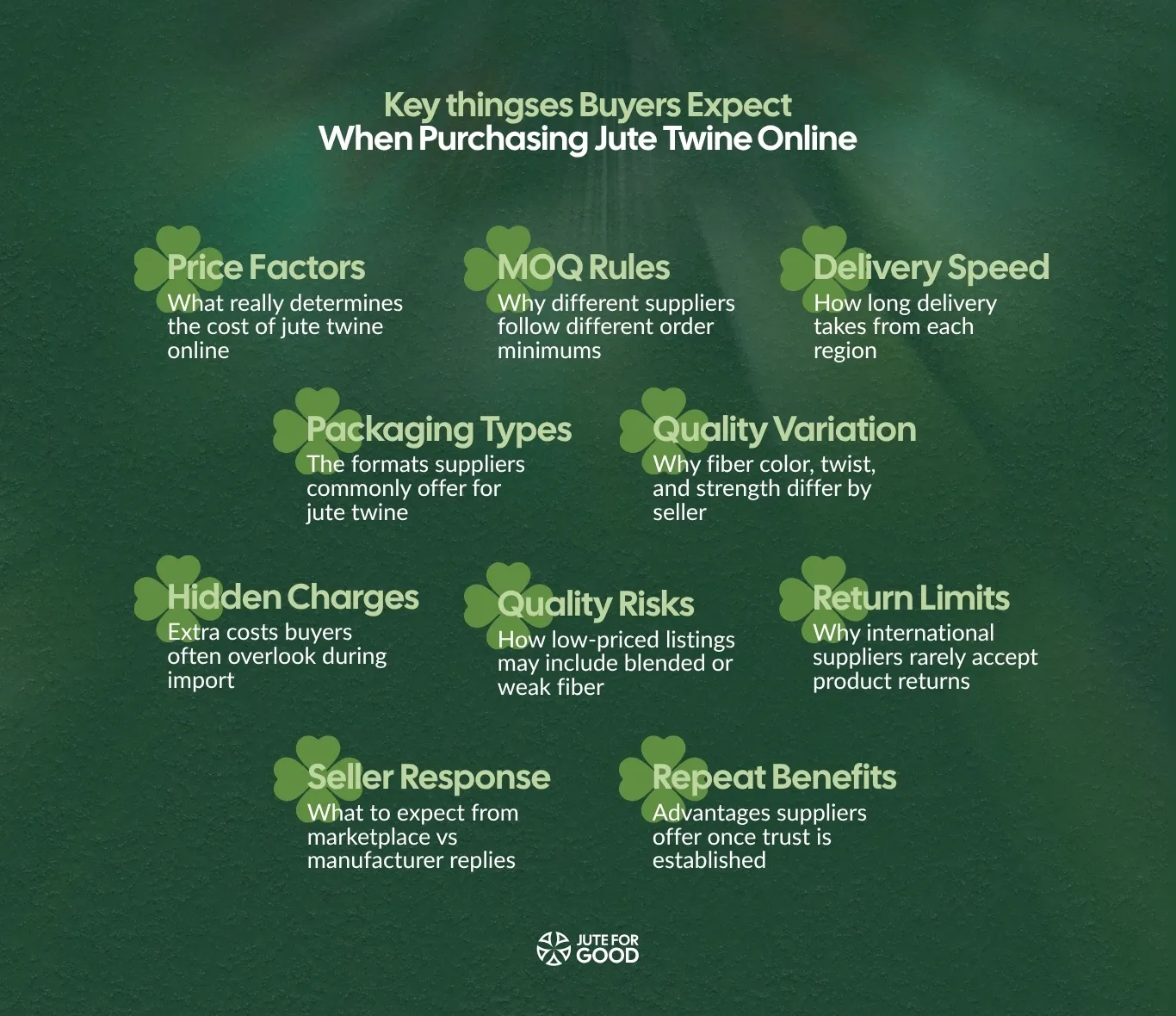
1. Pricing That Varies by Ply, Quality & Packaging
Online prices are not fixed. They depend on:
- Fiber grade (A, B, C quality)
- Ply count (1–6 ply)
- Natural, polished, or dyed options
- Packaging type (ball, spool, cone)
- Order quantity (small MOQs cost more per unit)
Expect an average online price of $1.10–$1.80 per KG, with lower rates available from direct manufacturers.
2. Minimum Order Quantities (MOQ)
Online suppliers usually follow standard MOQs:
- Marketplaces like Alibaba/IndiaMART: 20 KG – 200 KG
- Manufacturers in Bangladesh: 200 KG – 500 KG (flexible for new buyers)
- Distributors in the USA/EU: No MOQ, but higher prices
Small MOQs are ideal for sampling or starting new retail lines.
3. Shipping & Delivery Timelines
Shipping differs by region and platform:
- Local distributors (USA/EU): 2–5 days
- Online marketplaces (IndiaMART/AliExpress): 1–3 weeks
- Direct manufacturers (Bangladesh):
- Asia: 5–12 days
- Middle East: 10–15 days
- EU: 18–25 days
- USA: 28–32 days
Buyers should always confirm CIF or FOB terms before ordering.
4. Packaging Options
Online suppliers usually offer:
- Ball packaging – retail use
- Spool packaging – agriculture & gardening
- Cone packaging – industrial factories
- Private label options – custom branding for wholesalers
Expect slightly higher pricing for custom packaging.
5. Quality Differences Between Sellers
Online suppliers vary in terms of fiber quality. Expect differences in:
- Color (golden vs darker fiber)
- Twist consistency
- Ply strength
- Moisture content
- Polished vs unpolished finish
Always request sample pictures, videos, or physical samples before large orders.
6. Hidden Costs Importers Often Overlook
Beyond product cost, be prepared for:
- International shipping
- Customs duties or VAT
- Palletizing charges
- Label printing fees
- Port handling charges
Some marketplace sellers add extra fees for packaging or documentation.
7. Risk of Blended or Low-Quality Fiber
Cheaper online listings often include:
- Synthetic fiber blends
- Underweight spools
- Weak tensile strength
- Non-uniform coloring
- No certifications
Buyers should request:
- SGS test reports
- Hydrocarbon-free certification
- Fiber grade details
- Production videos
8. Return & Refund Policies
Online platforms usually allow returns only if:
- The product is damaged
- Weight shortage is proven
- The wrong size/ply/color was delivered
Direct manufacturers rarely accept returns due to international shipping cost.
This makes sample approval extremely important.
9. Communication & Response Time
Expect:
- Marketplace sellers: delayed or inconsistent communication
- Direct manufacturers: more detailed responses, but different time zones
- Distributors: quick replies but higher pricing
Working with verified exporters ensures faster and more reliable negotiation.
10. Better Pricing for Repeat Buyers
Once trust is built, suppliers often offer:
- Volume discounts
- Faster production
- Priority packaging
- Private-label options
- Extended credit (for very long-term buyers)
Frequently Asked Questions (FAQ)
Where Can I Buy Jute Twine in Bulk?
You can buy bulk jute twine directly from manufacturers in Bangladesh, through regional distributors in the USA, UK, and EU, or from global B2B marketplaces. Direct sourcing from Bangladesh offers the most competitive factory pricing, while local distributors offer faster delivery for smaller quantities.
Is Bangladesh the Best Country for Wholesale Jute Twine?
Yes, Bangladesh is considered the best sourcing destination due to its large jute production capacity, competitive pricing, and internationally recognised quality standards. More than 80 percent of the world’s export-grade jute twine is supplied by Bangladeshi factories.
What Ply Is Best for Packaging Use?
For lightweight packaging, 2 ply is commonly used. For warehouse bundling or agricultural applications, 3 ply to 6 ply provides stronger tensile strength. Importers select ply based on the load requirements of their specific market.
How Long Does Shipping From Bangladesh Take?
Shipping usually takes between 15 and 30 days depending on the destination. Middle Eastern and Asian countries receive goods faster, while shipments to the USA and Europe require longer transit times.
How Can I Avoid Low-Quality or Blended Jute Twine?
Requesting a sample before placing a bulk order helps verify fiber grade, twist strength, and ply consistency. Buyers should also ask for ISO, OEKO-TEX, and SGS documentation and confirm that the twine is hydrocarbon-free when needed.
What Certifications Should I Check Before Ordering?
Common certifications include ISO for quality management, OEKO-TEX for material safety, and SGS for fiber testing. Hydrocarbon-free certificates are important for buyers dealing with food-contact packaging.
What Is the Average Price per Kilogram for Jute Twine?
Bulk prices generally range between 1.1 and 1.6 USD per kilogram for standard grades. Premium variants such as polished, dyed, or hydrocarbon-free twine may cost slightly more due to additional processing.
Conclusion
Jute twine continues to grow in global demand as buyers look for natural and biodegradable packaging materials. Importers choose it for agriculture, retail, shipping, manufacturing, and craft use because it is affordable, strong, and environmentally safe. Bangladesh remains the most reliable and cost-effective source due to its large-scale production, raw fiber availability, and strong export infrastructure. Whether buying through manufacturers, local distributors, or online marketplaces, importers gain the best value by checking fiber quality, ply strength, packaging type, certification, and documentation. A clear specification sheet and sample approval help ensure smooth production and consistent results across every shipment