

Jute manufacturing refers to the conversion of bast fibers from the Corchorus plant into industrial materials such as yarn, fabric, sacks, ropes, and geotextiles. According to the Food and Agriculture Organization (FAO), global jute production exceeds 3 million metric tons annually, with Bangladesh and India contributing more than 90% of the global supply.
The fiber is valued for its biodegradability, low carbon footprint, and high tensile strength, making it a key material in sustainable packaging and agricultural logistics. Rising environmental regulations and plastic reduction policies across Europe and Asia have increased global demand for natural fibers, reinforcing jute’s role in eco-friendly manufacturing and circular material systems.
The complete journey of jute production occurs in two major phases. The first phase covers the agricultural stage, where jute is cultivated and processed from seed to raw fiber ready for the market.
The second phase involves the industrial stage, where raw jute fiber is transformed into manufactured products such as yarn, fabric, sacks, and other materials.
These steps are typically divided into two main phases:
- Phase 1: The Agricultural Process (Field to Raw Fiber)
- Phase 2: The Industrial Process (Mill Production)
Phase 1: The Agricultural Process (Field to Raw Fiber)
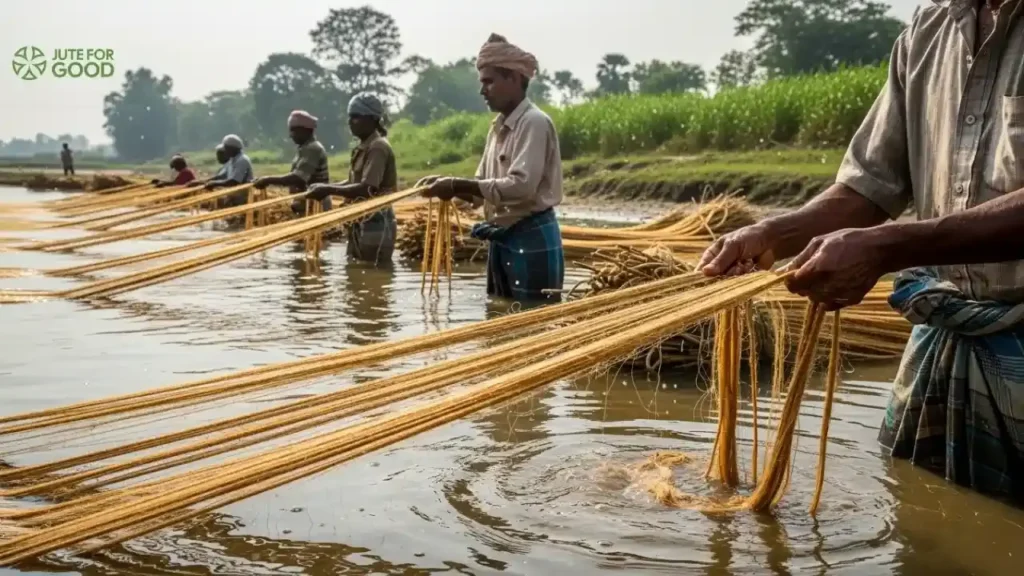
The agricultural phase defines the strength, color, and quality of jute fiber. Everything that happens in the field directly affects mill efficiency and final product durability.
1. Cultivation and Harvesting
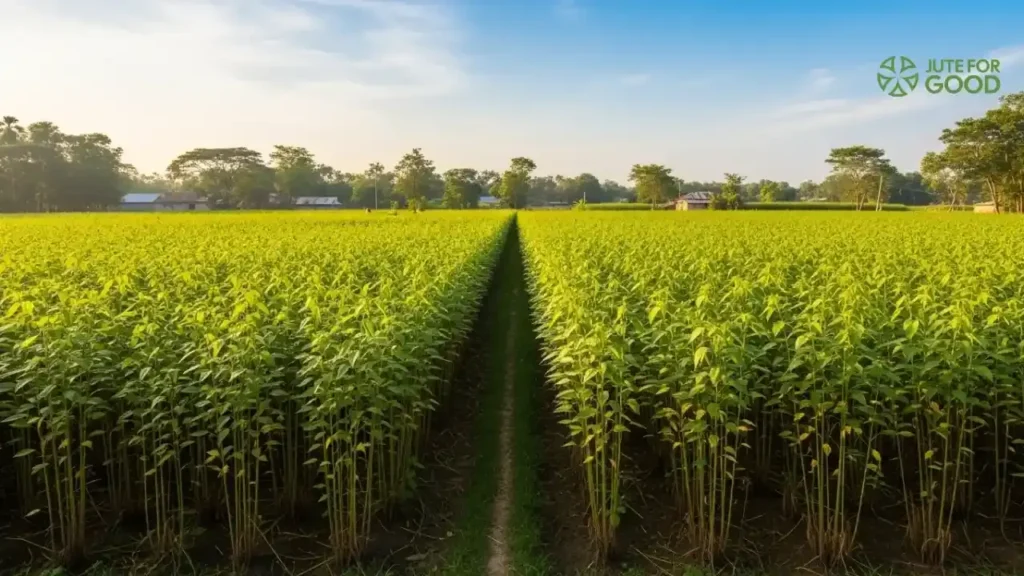
Cultivation and harvesting define the physical and chemical quality of raw jute fiber because soil fertility, climate conditions, and harvest timing directly influence fiber strength, length, and color.
Farmers prepare land through ploughing and leveling to ensure even growth. Jute requires well drained loamy soil rich in organic matter. Studies from agricultural research institutes in Bangladesh show that proper nitrogen and potassium management increases fiber yield by up to 15 percent.
During the growth cycle, thinning and weeding are essential. Overcrowded plants produce thinner stems and weaker fibers. Controlled spacing improves sunlight exposure and nutrient absorption.
Harvesting is done manually using sickles. The stems are cut close to the ground to maximize usable fiber length. Each bundle usually contains 15 to 25 stalks. Proper bundling prevents tangling during retting.
The quality of fiber at this stage determines how efficiently it will process in mills later. Strong and uniform fibers reduce waste during carding and spinning.
2. Retting: The Most Critical Step in Fiber Separation
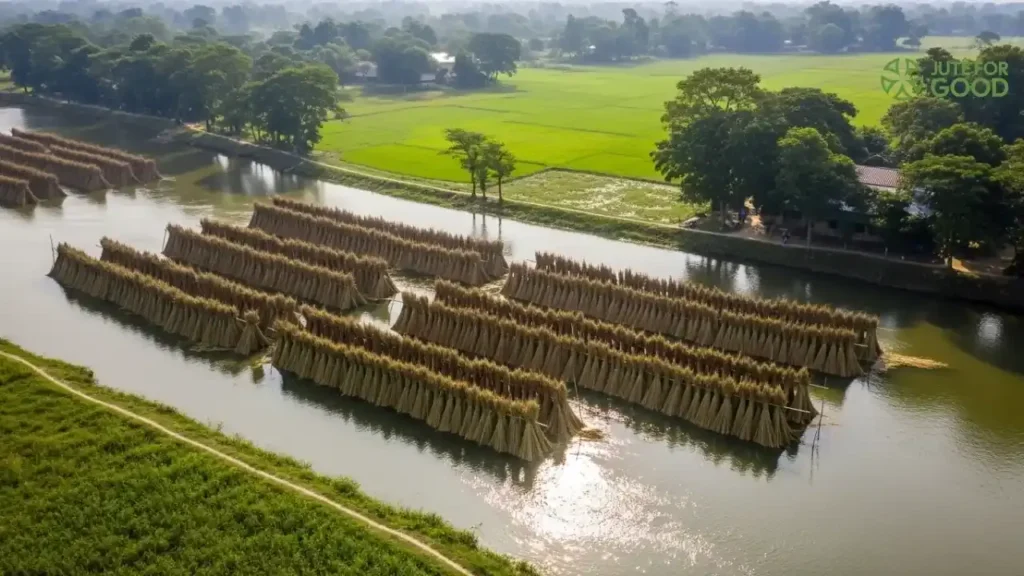
Retting is a biological process in which harvested jute stalks are submerged in water for 10 to 30 days so that natural microbes break down the pectin binding the fiber to the woody core.
This step is widely considered the most important stage in jute manufacturing because it directly affects fiber color, texture, and tensile strength. During retting, bacteria dissolve the gummy substances surrounding the bast fibers. If retting is incomplete, fibers remain rough and difficult to separate. If it is overdone, fibers lose strength.
Traditional retting is carried out in slow moving rivers, ponds, or canals. The bundles are placed underwater and weighed down with logs or stones. Water temperature and microbial activity influence the duration. Warmer water speeds up fermentation.
When retting is complete, the outer bark loosens from the woody stem. Workers then move to the stripping stage.
3. Stripping or Fiber Extraction
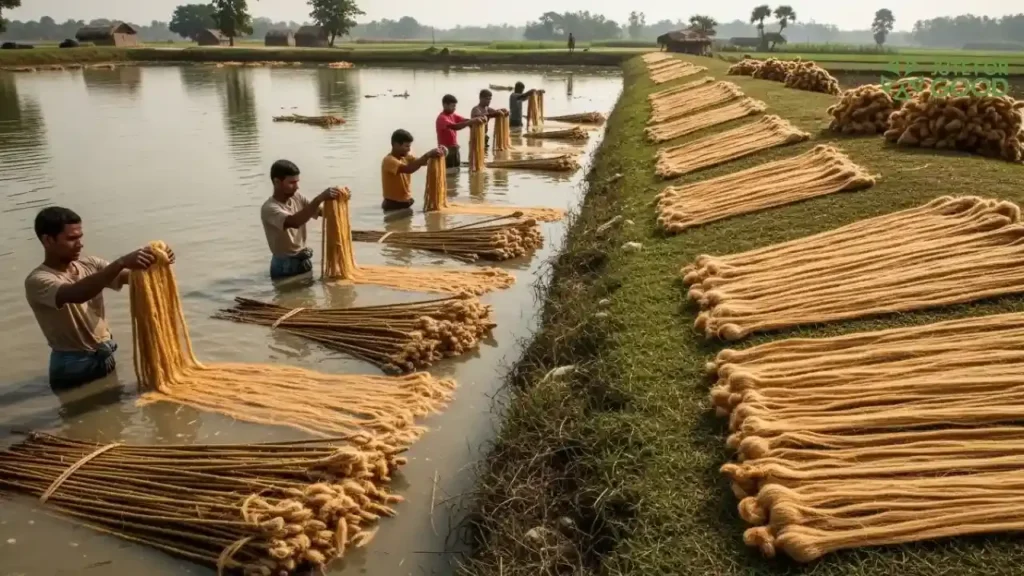
Stripping is the manual removal of jute fibers from retted stalks, separating the long bast fibers from the woody inner core.
Workers stand in water and break the root end of each stalk. The fiber is gently pulled away in long strands. Skilled workers can extract fiber from multiple stalks in one motion. This traditional method remains common in rural regions because it requires minimal tools.
The extracted fibers are long, soft, and ribbon like. Their average length ranges from 1.5 to 4 meters depending on plant variety and harvest timing. Fiber length plays a major role in yarn strength during spinning.
4. Washing and Sun Drying
Washing and sun drying remove impurities and reduce moisture content so that raw jute can be stored safely without fungal growth.
Once fibers are stripped, they are rinsed repeatedly in flowing water. This washing step improves color and removes decayed plant matter. Clean fiber fetches higher prices in local markets.
After washing, fibers are spread on bamboo racks or hung on lines under sunlight. Drying typically takes two to three days depending on humidity. Moisture content must be reduced to around 12 to 14 percent for safe storage.
Proper drying prevents microbial damage and preserves tensile strength. Fibers that remain damp can develop mold, reducing quality and export value.
5. Grading and Baling of Raw Jute Fiber
Grading and baling classify raw jute fibers based on strength, color, length, and fineness before they are sent to mills for industrial processing.
Grading is done visually and manually in most producing regions. Experts assess fiber brightness, root content, uniformity, and defects. Higher grades are lighter in color and more uniform in thickness.
In Bangladesh, raw jute is categorized into several grades such as TD1 to TD8 for Tossa jute. TD1 represents superior quality while lower grades indicate coarser or darker fibers.
After grading, fibers are pressed into bales weighing around 150 to 180 kilograms. Hydraulic presses compress the fibers tightly for easier transport. Proper baling protects fiber from moisture and contamination during shipment.
These bales are then delivered to jute mills, where the industrial process begins.
Phase 2: The Industrial Process (Mill Production)
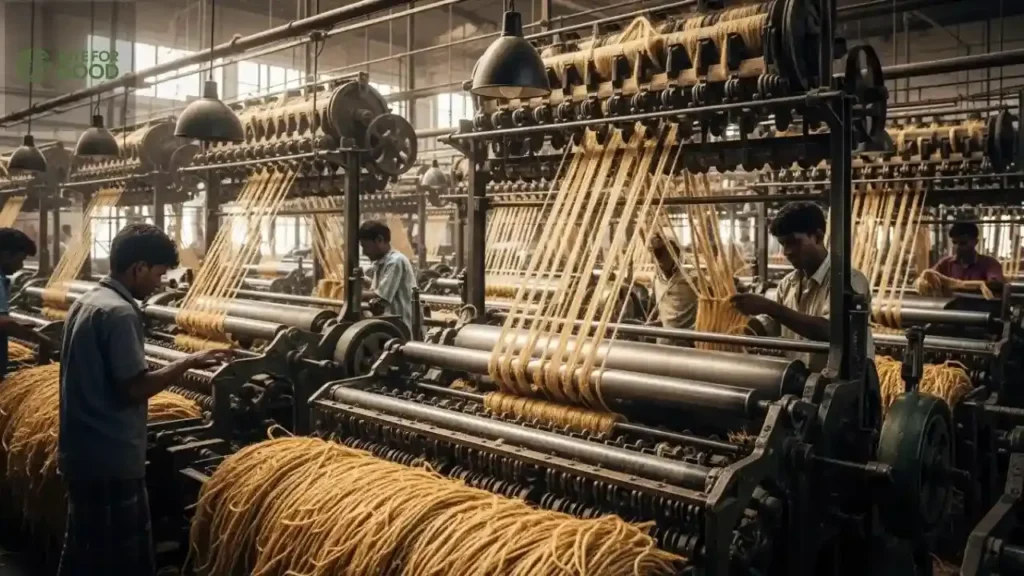
The industrial process converts raw jute fiber into yarn, fabric, and finished goods through mechanical processing. This phase focuses on alignment, softening, twisting, and weaving fibers into structured materials.
Modern jute mills operate with a combination of traditional machinery and updated automation systems. Bangladesh alone operates over 150 jute mills across public and private sectors.
6. Batching and Fiber Softening
Batching is the controlled mixing and softening of raw jute fibers before mechanical processing. It prepares fibers for carding and spinning by improving flexibility and cohesion.
In this stage, fibers are spread out and sprayed with a measured emulsion made of water and mineral oil. The moisture content is raised to about 14 to 16 percent to increase pliability.
Fibers are then piled and left for 24 to 48 hours in a process known as conditioning or maturing. This resting period allows moisture to penetrate evenly.
7. Carding
Carding disentangles, cleans, and aligns jute fibers into a continuous sliver suitable for further refinement.
In the breaker card, large bundles are opened and partially aligned. Woody particles called shives are removed during this stage. The output is a thick sliver.
The sliver then passes through the finisher card. This machine improves fiber parallelism and further removes impurities. The result is a more uniform ribbon of fibers.
8. Drawing
Drawing improves sliver uniformity by combining multiple slivers and stretching them to achieve consistent thickness.
In drawing frames, several slivers are fed together and drafted through rollers rotating at different speeds. This process equalizes weight variations and enhances fiber parallelism.
Multiple drawing passages are often used. Each passage improves evenness and reduces irregularities. Textile studies show that consistent drafting improves tensile strength and reduces yarn defects.
9. Spinning
Spinning converts drawn slivers into yarn by applying controlled twist to bind fibers together into a strong continuous thread.
In jute spinning frames, fibers are drafted to the desired thickness and twisted simultaneously. The amount of twist determines yarn strength and flexibility. Higher twist increases strength but may reduce softness.
Jute yarn counts typically range from 5 lbs to 20 lbs per spindle, depending on application. Stronger yarn is used for sacking bags, while finer yarn suits decorative fabrics.
10. Weaving and Fabric Production
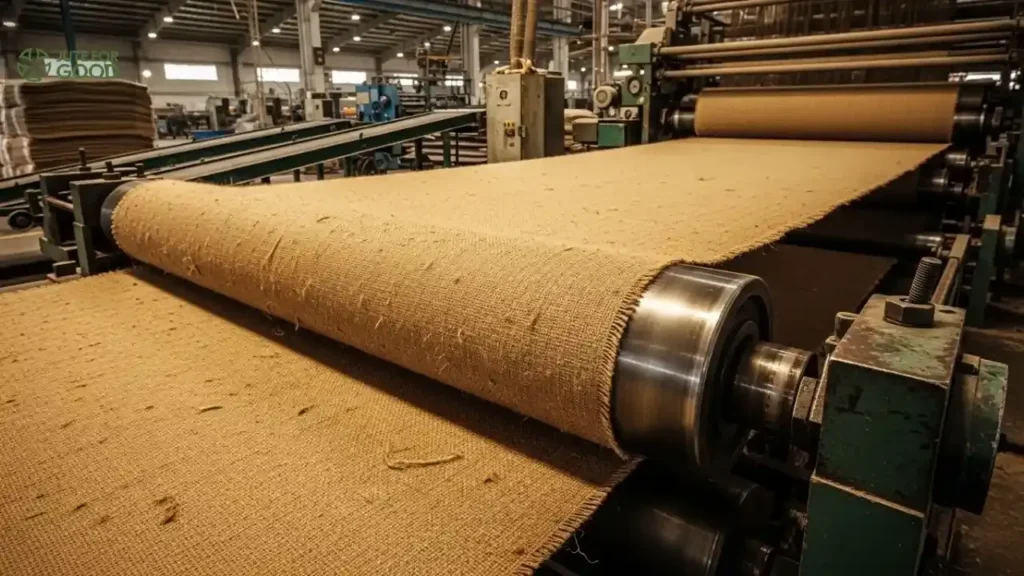
Weaving interlaces warp and weft yarns to create jute fabrics such as hessian cloth and sacking material.
Warp yarns are arranged lengthwise on a loom, while weft yarns pass across them. The tightness of the weave determines fabric density. Hessian cloth has a lighter plain weave, while sacking fabric is heavier and more durable.
11. Finishing and Fabric Processing
Finishing enhances the texture, appearance, and usability of woven jute fabric through treatments such as calendaring, dyeing, or laminating.
Calendaring smooths fabric by passing it through rollers under pressure. Dyeing adds color for decorative or branding purposes. Some fabrics receive fire retardant or water resistant treatments.
Hydrocarbon free processing has become important for food-grade packaging. Export markets increasingly demand eco-friendly compliance and safety standards.
After finishing, fabric is rolled, inspected, and prepared for conversion into final products.
What are the Main Types of Manufactured Jute Products?
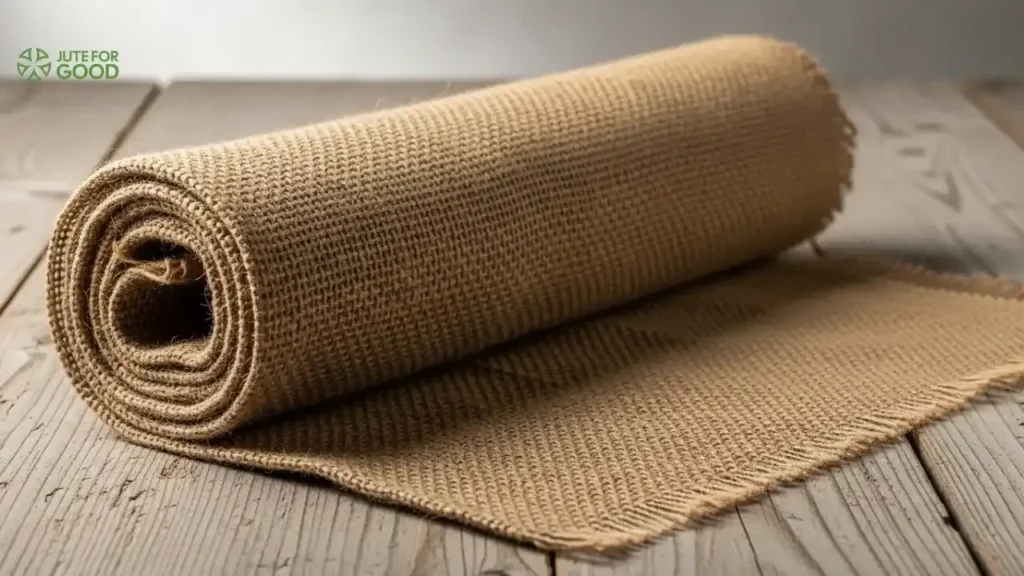
Jute manufacturing produces a wide range of biodegradable products used in agriculture, packaging, construction, and home décor worldwide.
Global demand for sustainable materials has increased steadily. The global jute products market was valued in the billions of dollars in recent years, driven by restrictions on plastic packaging and rising environmental awareness.
Below are the primary product categories derived from jute fiber.
Hessian Cloth Burlap
Hessian cloth, also known as burlap, is a lightweight, plain woven jute fabric used for packaging, decoration, and agricultural covering.
It is breathable and biodegradable. Farmers use it to wrap plant roots and protect crops. In retail, it is used for coffee bags and decorative packaging.
Hessian fabric weights typically range from 5 to 12 ounces per square yard. Its open weave allows air circulation, preventing moisture buildup in stored goods.
Heavy Sacking Bags
Heavy sacking bags are thick woven jute sacks designed for bulk storage and transportation of agricultural commodities.
These bags can carry 50 to 100 kilograms of products such as rice, wheat, potatoes, and coffee beans. Their tensile strength and tear resistance make them reliable for export logistics.
Jute Yarn and Rope
Jute yarn and rope are twisted fiber products used in textiles, handicrafts, carpet backing, and industrial tying applications.
Rope diameter and strength vary depending on twist level and fiber grade. Jute rope remains widely used in agriculture and marine settings due to its grip and biodegradability.
Yarn also serves as the base for carpets and geotextiles, which help control soil erosion in infrastructure projects.
Frequently Asking Question
Which country is the largest jute exporter?
Bangladesh is the largest exporter of jute and jute-based products in the world. The country supplies a major share of global jute yarn, hessian cloth, sacking bags, and diversified jute goods to international markets.
Bangladesh exports jute products to more than 100 countries, including major buyers in Europe, the Middle East, and Asia. Its export strength comes from abundant raw jute supply, a large network of jute mills, and decades of experience in fiber processing and international trade.
Which country is best for jute?
Bangladesh and India are the best countries for jute cultivation because their climate and soil conditions support optimal fiber growth. Warm temperatures, heavy rainfall, and fertile alluvial soil create ideal growing environments.
The Ganges–Brahmaputra delta region provides these natural conditions. Bangladesh is widely known for producing high-quality raw jute with long and strong fibers, while India, especially West Bengal has large cultivation areas and extensive jute mill infrastructure.
What is the ranking of Bangladesh in jute production?
Bangladesh ranks as the second-largest jute producer in the world after India. The country contributes approximately 30–35% of global raw jute production each year according to international agricultural statistics.
In addition to strong agricultural output, Bangladesh plays a major role in global trade by exporting large volumes of jute yarn, fabrics, and sacking materials to international markets.
Which country is No. 1 in jute production?
India is the number one jute producer in the world. The country generates roughly 50–55% of global raw jute output, making it the largest contributor to worldwide production.
Most Indian jute is grown in the eastern states such as West Bengal, Assam, and Bihar, where climate conditions favor cultivation. Bangladesh remains the second-largest producer and the leading exporter of processed jute products.
Conclusion
Jute manufacturing begins with cultivation in fertile river basins and moves through retting, stripping, washing, grading, and baling before entering mills for mechanical processing.
In industrial production, batching, carding, drawing, spinning, and weaving convert raw fiber into yarn, fabric, sacks, and rope.
Global output exceeds 3 million metric tons annually, led by India in production and Bangladesh in exports.
Its strength, biodegradability, and low environmental impact make jute essential in sustainable packaging and agricultural supply chains.