

Jute yarn manufacturing refers to the industrial conversion of raw jute fiber into spun yarn used in textiles, ropes, carpets, geotextiles, and bulk packaging materials. The global jute market was valued at $2.8 Billion in 2024 and is projected to reach $5 Billion by 2034 (CAGR 5.8%).
India and Bangladesh remain the global leaders. In Bangladesh, the jute sector contributes approximately 1% to the National GDP and 3% of total export earnings (as of 2025/26 data). Rising environmental regulations in Europe and Asia have accelerated demand for natural fibers in the packaging and construction sectors.
As a renewable, biodegradable, and carbon-efficient fiber, jute plays a critical role in sustainable manufacturing and global supply chains, making it a focal point for exporters, textile engineers, and eco-conscious buyers.
In this blog, I will explain jute yarn manufacturing Process in 6 steps such as:
- Step 1: Jute Harvesting
- Step 2: Retting (Biological Process)
- Step 3: Stripping and Drying
- Step 4: Softening and Conditioning
- Step 5: Carding (Fiber Separation)
- Step 6: Spinning (Fiber to Yarn)
Let’s explore in details
Step 1: Jute Harvesting
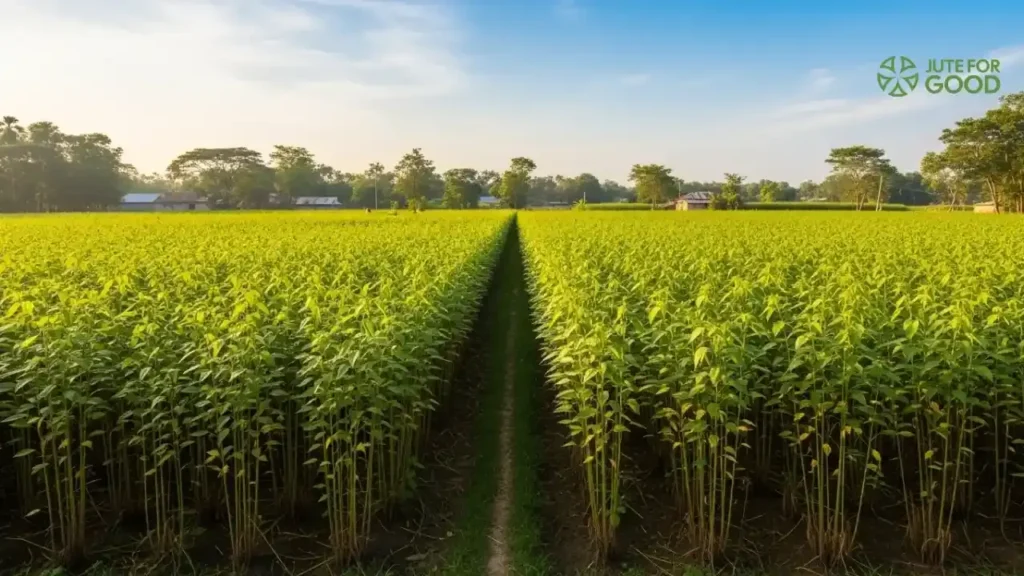
Jute harvesting is the process of cutting mature jute plants at the correct growth stage to ensure optimal fiber strength, length, and quality.
Jute plants typically reach maturity within 100 to 120 days after sowing. Farmers harvest the crop when the plants begin flowering. Harvesting too early reduces fiber strength, and harvesting too late makes fibers coarse and brittle.
The plants usually grow between 8 and 12 feet tall under warm and humid conditions. Ideal growth requires temperatures between 24 to 37 degrees Celsius and annual rainfall of 1500 mm or more.
After cutting, the stalks are tied into bundles. These bundles are transported to water bodies for retting.
The timing of harvesting directly affects fiber fineness and tensile strength. Studies from the Bangladesh Jute Research Institute show that properly timed harvesting improves fiber strength by up to 15 percent compared to delayed harvesting.
Step 2: Retting (Biological Process)
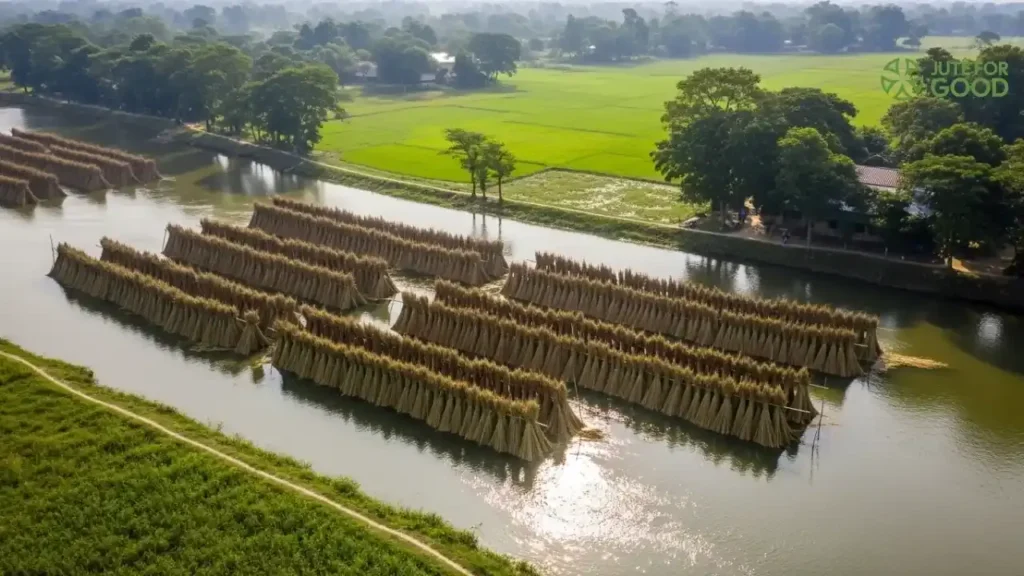
Retting is a microbial process where harvested jute stalks are soaked in water to separate fiber from the woody core through controlled decomposition.
Retting is one of the most critical stages in jute yarn manufacturing. During this process, natural bacteria break down pectin and other binding materials that hold fiber to the stem.
Bundles of jute stalks are submerged in slow-moving or stagnant water for 10 to 20 days. The duration depends on water temperature and microbial activity. Warmer water speeds up retting, while colder water slows it down.
Research indicates that water temperature between 30 to 34 degrees Celsius provides optimal retting results. The quality of retting directly influences yarn smoothness, color, and strength.
Step 3: Stripping and Drying
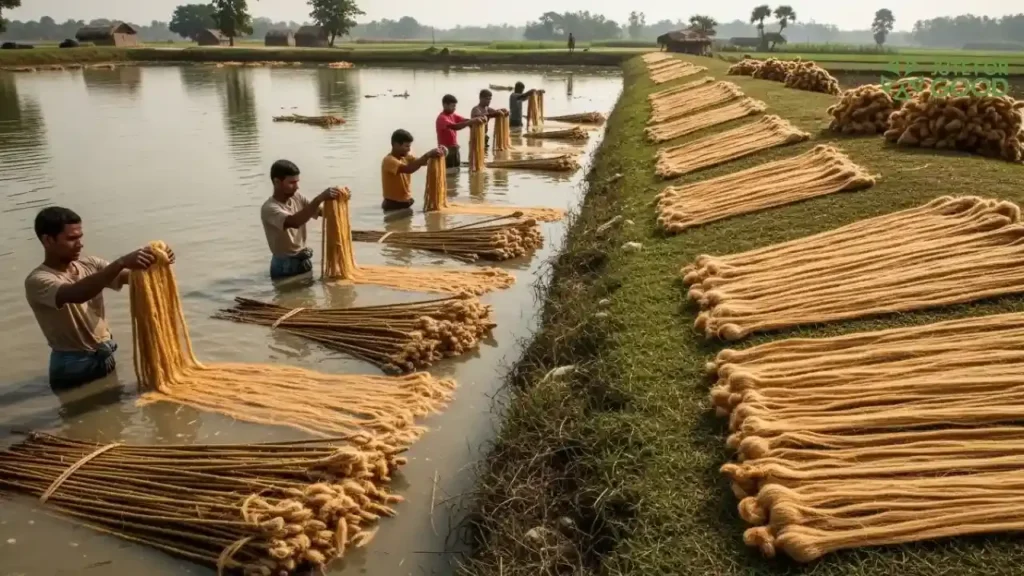
Stripping is the manual removal of jute fiber from retted stalks, followed by washing and drying to prepare clean raw fiber for processing.
Once retting is complete, workers remove fiber by hand. This process is called stripping. The fiber is pulled from the stem in long strands.
After stripping, the fiber is washed thoroughly to remove impurities and decomposed materials. Clean water washing improves brightness and reduces microbial residue.
The fibers are then dried under sunlight for two to three days. Proper drying prevents fungal growth and maintains fiber strength. Moisture content is usually reduced to around 12 to 14 percent before storage.
At this stage, raw jute fiber is ready for industrial processing.
Step 4: Softening and Conditioning
Softening and conditioning prepare raw jute fibers for mechanical processing by improving flexibility, reducing stiffness, and ensuring uniform moisture distribution.
Raw jute fiber is naturally stiff due to lignin content.
To make it suitable for spinning, it must be softened. This is done by applying a measured emulsion of water and oil.
The fiber passes through a softening machine where the emulsion is sprayed evenly. This improves pliability and reduces breakage during carding.
Emulsion Recipe
An emulsion is a carefully measured mixture of water and mineral or vegetable oil used to condition jute fibers before carding.
Typically, mills use about 15 to 25 percent water mixed with 2 to 5 percent oil. The exact ratio depends on fiber grade and environmental humidity.
Vegetable oils are increasingly used due to sustainability concerns. Proper emulsion application can reduce fiber breakage by nearly 30 percent during carding, according to textile engineering reports.
Pilling
Pilling is the resting period after softening, where conditioned fibers are stored in piles to allow uniform absorption of moisture and oil.
After emulsion treatment, fibers are stacked in piles for 24 to 48 hours. This stage allows the moisture to penetrate evenly.
Step 5: Carding (Fiber Separation)
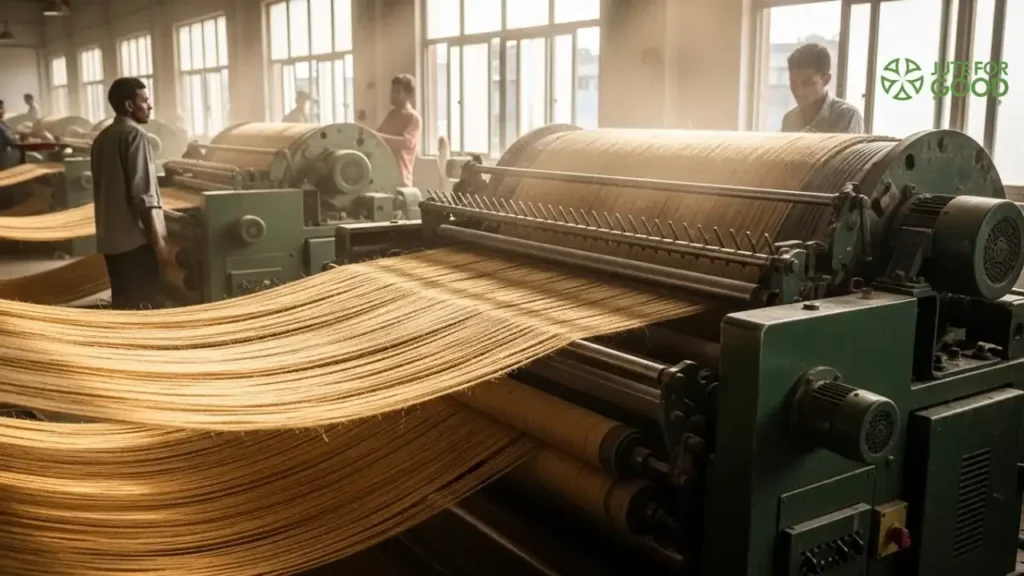
Carding is the mechanical process that separates, cleans, and aligns jute fibers into a continuous sliver for spinning.
Carding transforms loose fiber into an organized strand. It removes short fibers, dust, and remaining woody particles.
The process happens in two main stages. It is important to understand that carding determines fiber parallelism. Better alignment improves yarn strength and uniformity.
Breaker Card
The breaker card is the first stage of carding where large fiber bundles are opened and partially aligned.
Fibers pass through a series of pinned rollers that separate clumps. The machine converts bulk fiber into a thick strand called a sliver.
Breaker carding removes heavy impurities. It also begins the alignment process. Studies in textile mills show that proper breaker card settings improve sliver uniformity by 10 to 15 percent.
Finisher Card
The finisher card refines the sliver by improving fiber alignment and removing remaining short fibers and impurities.
This stage produces a smoother and more uniform sliver. Better alignment leads to improved tensile strength. Uniform slivers reduce variations in yarn thickness during spinning.
Carded slivers are now ready for drawing and spinning.
Step 6: Spinning (Fiber to Yarn)
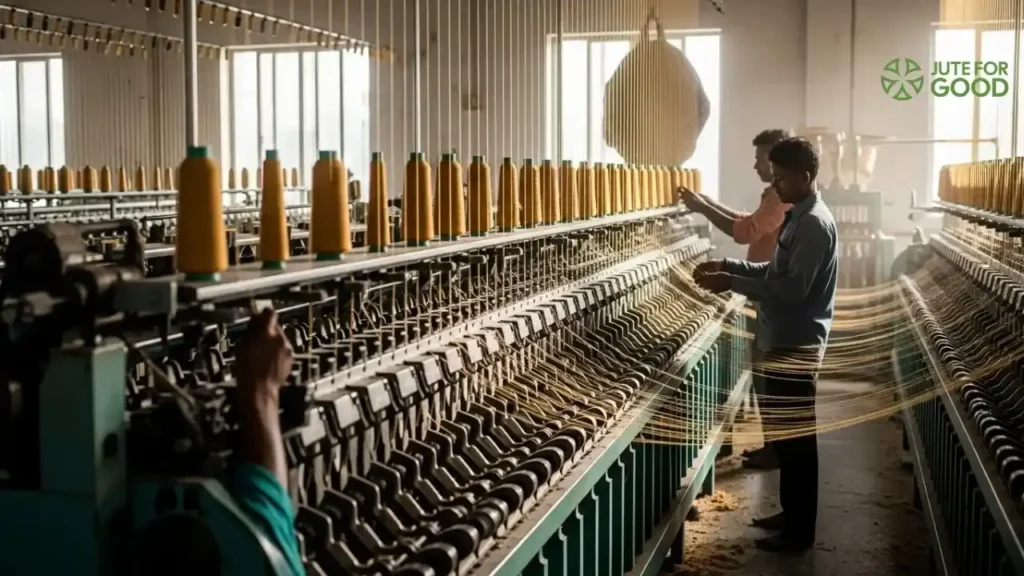
Spinning is the mechanical process that converts aligned jute slivers into continuous, strong yarn through drafting, twisting, and winding.
Spinning is the stage where fiber becomes a usable product. It determines yarn strength, thickness, and uniformity. Even small variations in tension or twist can affect final quality.
Modern jute mills use flyer spinning frames or slip draft spinning systems. These systems control fiber tension and twist speed. Proper calibration ensures consistent yarn count and strength.
Research in textile engineering shows that optimized spinning conditions can improve yarn tensile strength by 12 to 18 percent. This directly affects the durability of jute bags, ropes, carpets, and industrial fabrics.
1. Drafting
Drafting is the process of stretching the sliver to reduce thickness and align fibers more closely before twisting.
During drafting, multiple slivers are combined and drawn out between rollers rotating at different speeds. The front rollers move faster than the back rollers. This stretches the fiber strand.
The purpose of drafting is to achieve the required yarn count. Jute yarn count is commonly measured in pounds per spindle or tex system. For example, a 7 lbs spindle yarn is thicker than a 10 lbs spindle yarn.
2. Twisting
Twisting binds drafted fibers together by rotating them around a central axis, creating cohesion and tensile strength.
Twist is what transforms loose fibers into strong yarn. Without twist, the strand would fall apart.
In jute spinning, twist per meter varies depending on yarn application. Rope yarn requires higher twist levels than carpet backing yarn. On average, jute yarn may have 100 to 300 twists per meter.
3. Winding
Winding is the process of transferring spun yarn onto bobbins, cones, or spools for storage, transport, or further processing.
Winding ensures that yarn is evenly layered and free from tangles. Proper winding prevents tension issues during weaving or knitting.
Automatic winding machines monitor yarn breaks. If breakage occurs, the system stops to avoid defects. This improves overall production efficiency.
Technical Specifications & Quality Ratios
Technical specifications define the measurable performance of jute yarn, including count, tensile strength, twist per meter, and moisture regain. These values determine whether yarn is suitable for hessian cloth, sacking fabric, carpet backing, or rope production.
Standardized testing under controlled humidity ensures consistent quality, especially for export markets where strength and uniformity directly impact fabric durability and load-bearing capacity.
Technical Specifications & Quality Ratios in a table
| Property | Standard Hessian Warp | Sacking Warp |
| Typical Yarn Count | 9 to 11 lbs per spindle | 6 to 8 lbs per spindle |
| Tex Range | 280 to 350 tex | 350 to 500 tex |
| Tensile Strength | 250 to 320 MPa | 300 to 400 MPa |
| Twist per Meter | 140 to 180 TPM | 180 to 250 TPM |
| Moisture Regain | 12 to 14 percent | 12 to 14 percent |
| End Use | Light fabric, decorative cloth | Heavy-duty bags, bulk sacks |
| Uniformity CV Percent | Below 4 percent | Below 5 percent |
| Elongation at Break | 1.5 to 2 percent | 1.2 to 1.8 percent |
Sourcing Quality Jute Yarn for Industrial Use
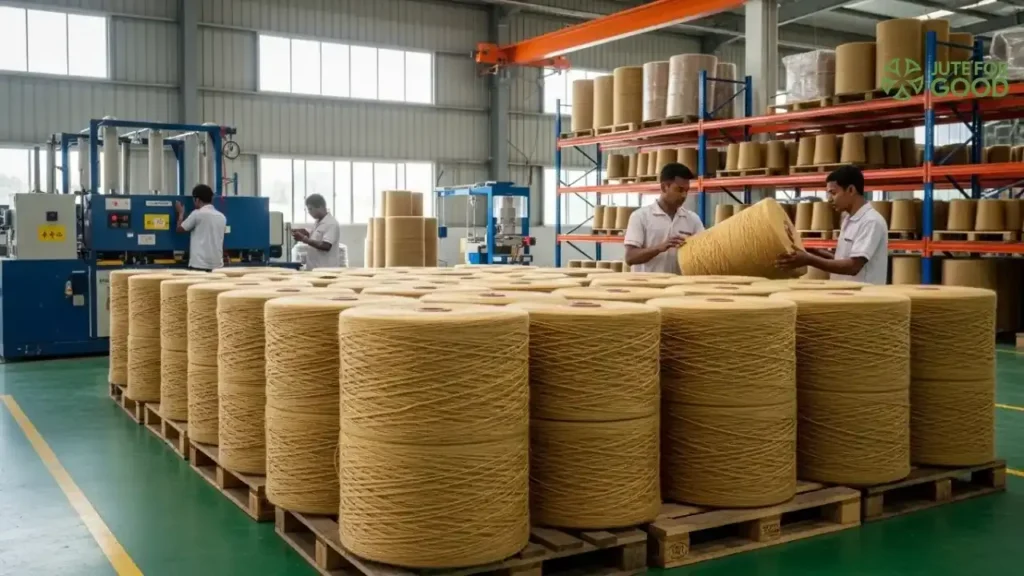
For manufacturers, exporters, and packaging companies, the consistency of jute yarn directly affects fabric strength, weaving efficiency, and final product durability. Reliable sourcing requires fibers that are properly retted, processed, and spun under controlled mill conditions.
Jute For Good is a company with experienced jute mills in Bangladesh to supply consistent, export-grade jute yarn used in hessian cloth, sacking fabric, ropes, and industrial textiles. Businesses looking for stable quality and bulk supply can explore available yarn specifications and sourcing options.
Frequently Asked Questions
Who is the largest producer of jute in the world?
India is the largest producer of jute in the world, accounting for more than half of global production. The country cultivates jute mainly in the eastern regions where climatic and soil conditions support fiber crops.
Bangladesh is the second-largest producer and is widely known for producing high-quality jute fiber, often called the “Golden Fiber.” Together, India and Bangladesh contribute over 90% of the world’s total jute production, supplying raw fiber for yarn, sacks, ropes, carpets, and eco-friendly packaging materials.
Which state is rich in jute?
West Bengal is the leading jute-producing state in India. The fertile alluvial soil of the Ganges–Brahmaputra delta, combined with warm temperatures and high humidity, creates ideal growing conditions for jute cultivation.
Major jute-growing districts include Hooghly, Nadia, Murshidabad, and North 24 Parganas. Other Indian states that produce jute include Assam, Bihar, Odisha, and Meghalaya, though West Bengal contributes the largest share of the country’s output.
What kind of soil is needed for jute?
Jute grows best in fertile alluvial soil rich in silt and organic matter. The crop requires soil that retains moisture while still allowing proper drainage.
River basin soils formed by annual flooding are particularly suitable because they provide natural nutrients and maintain soil fertility. The Ganges–Brahmaputra delta region is considered one of the most productive areas for jute cultivation due to its deep, loamy alluvial soil.
How long does jute take to grow?
Jute typically takes 100 to 120 days to reach harvest maturity after sowing. The exact growth period depends on the variety of jute and environmental conditions such as temperature, rainfall, and soil fertility.
Farmers harvest the plants when they reach 10–12 feet in height, before the fiber becomes coarse. After harvesting, the stalks undergo retting, a biological process that separates the fiber from the woody stem.
What season does jute grow in?
Jute is a monsoon-season crop grown primarily during the Kharif season in South Asia. Sowing usually takes place between March and May, depending on rainfall patterns and regional climate.
The crop grows during the warm and humid months and is typically harvested between July and September. Adequate rainfall, high humidity, and temperatures between 24°C and 37°C support optimal plant growth and fiber development.
Conclusion
Jute yarn manufacturing is a structured process that transforms raw plant fiber into strong industrial yarn through harvesting, retting, fiber extraction, conditioning, carding, and spinning. Each stage influences fiber alignment, tensile strength, and yarn uniformity.
Proper processing ensures that the yarn meets technical standards required for hessian fabrics, sacking materials, ropes, carpets, and geotextiles. As global demand for biodegradable and sustainable materials continues to grow, jute yarn remains a critical raw material in eco-friendly textiles and packaging industries worldwide.